What Are the Specifications of Eco-Friendly Knitting Yarn and How to Select Them?
The selection of eco-friendly knitting yarn involves a detailed evaluation of both environmental credentials and technical performance specifications. Key specifications include the fiber source and composition (organic, recycled, biodegradable), certified by standards like GOTS, GRS, or OCS; yarn count and twist affecting fabric weight and hand feel; What Are the Specifications of Eco-Friendly Knitting Yarn and How to Select Them? and colorfastness and chemical safety verified by OEKO-TEX Standard 100. For buyers, the challenge is to navigate this complex matrix to find yarn that meets stringent sustainability goals without compromising on performance or cost-effectiveness.
The Comprehensive Guide to Specifications and Selection of Eco-Friendly Knitting Yarn
Table of Contents
- Executive Summary: From Green Claims to Verifiable Specifications
- Part 1: Defining “Eco-Friendly” in Knitting Yarns: A Taxonomy of Materials
- 1.1. Organic Natural Fibers: GOTS-Certified Cotton, Wool, and Linen
- 1.2. Recycled Fibers: Post-Consumer (GRS) and Post-Industrial Sources
- 1.3. Biodegradable & Innovative Fibers: Lyocell (TENCEL™), Modal, Recycled Polyester
- 1.4. The Critical Role of Third-Party Certifications
- Table 1: Key Eco-Friendly Fiber Types and Their Certified Standards
- Part 2: Decoding Technical Specifications for Performance
- 2.1. Linear Density & Yarn Count: English Count (Ne), Metric Count (Nm), and Denier
- 2.2. Twist Level & Direction: Impact on Strength, Drape, and Spirality
- 2.3. Yarn Construction: Single, Plied, and Cabled Yarns for Different End-Uses
- 2.4. Color Specification: Solution-Dyed vs. Conventional Dyeing (Environmental Impact)
- Table 2: Technical Specification Comparison for Common Knitting Applications
- Part 3: The Selection Framework: Matching Yarn to Product and Values
- 3.1. For High-Volume Basic Apparel (T-shirts, Basics): Balancing Cost, Consistency, and Impact
- 3.2. For Premium & Fashion Knitwear: Prioritizing Aesthetics, Hand Feel, and Story
- 3.3. For Home Textiles & Toys: Emphasizing Safety, Durability, and Wash Performance
- 3.4. For Technical and Outdoor Applications: Functional Needs (Moisture, Strength) + Sustainability
- Table 3: Eco-Yarn Selection Matrix by End-Use Application
- Part 4: Sourcing Deep Dive: The China Factor in the Green Yarn Supply Chain
- 4.1. China’s Evolving Role: From Low-Cost to Green-Tech Leader
- 4.2. Supplier Segmentation: Vertically Integrated Giants vs. Specialized Sustainable Mills
- 4.3. Cost Analysis: Premium Drivers and Long-Term Value Proposition
- Part 5: Quality Assurance and Risk Mitigation for Buyers
- 5.1. Auditing the Certificate: How to Authenticate GRS, OCS, and GOTS Claims
- 5.2. Lab Testing Protocols: Essential Physical and Chemical Tests for Incoming Yarn
- 5.3. Managing Consistency: Addressing Batch-to-Batch Variation in Recycled Content
- Part 6: Future Trends and Innovations in Sustainable Yarns
- 6.1. Next-Gen Recycled Fibers: Chemical Recycling of Blends and Textile Waste
- 6.2. Carbon-Negative and Regenerative Agriculture Fibers
- 6.3. Digital Passports and Blockchain for Full Supply Chain Transparency
- Frequently Asked Questions (FAQ)
- Conclusion: Building a Credible and Competitive Sustainable Product Line
1. Executive Summary: From Green Claims to Verifiable Specifications
For today’s industrial buyer, sourcing eco-friendly yarn has shifted from a niche marketing exercise to a core supply chain requirement. However, the market is rife with ambiguity. The term “eco-friendly” is not a specification; it’s a claim that must be substantiated by verifiable data points and certified standards. This guide provides a comprehensive framework to cut through the noise, focusing on the precise technical and environmental specifications that matter. You’ll learn how to differentiate between types of recycled polyester, interpret the true meaning of certifications, and select yarns that deliver on both sustainability promises and the demanding performance needs of modern knitting machinery and end consumers.
2. Part 1: Defining “Eco-Friendly” in Knitting Yarns
Eco-friendly yarns are defined by their reduced environmental impact across the lifecycle. This is broken down into three primary categories, each with distinct certifications.
Table 1: Key Eco-Friendly Fiber Types and Their Certified Standards
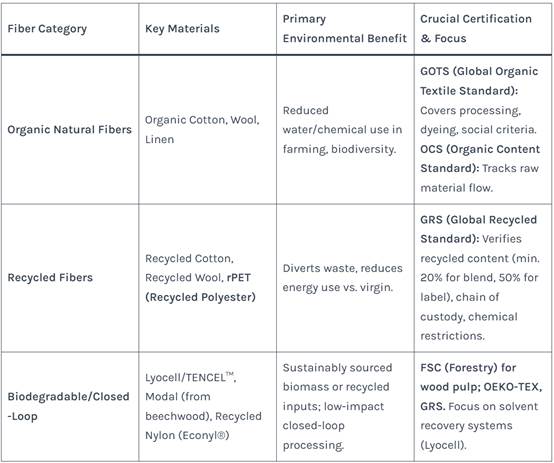
- Important Note on Recycled Polyester (rPET): Specify the source. Post-consumer (PCR) from bottles is more valuable than post-industrial (PIR) waste. A GRS certificate with a Transaction Certificate (TC) is non-negotiable for proof.
3. Part 2: Decoding Technical Specifications for Performance
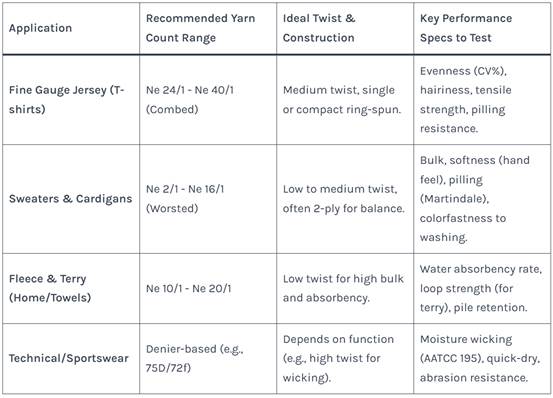
Sustainability must not come at the cost of performance. These technical specs are paramount:
- Yarn Count: Defines fineness. A finer count (e.g., Ne 40/1) produces lighter, drapier fabrics, while a coarser count (Ne 10/1) is for heavy sweaters or upholstery.
- Twist Level: Low-twist yarns are softer and bulkier; high-twist yarns are stronger, more durable, and less prone to pilling but can be harder. For knitwear, twist affects “spirality” in single jersey—a balanced ply is often required.
- Yarn Construction: Single yarns are common for weft knitting; plied yarns (2-ply, 3-ply) offer better strength, evenness, and reduced spirality.
Table 2: Technical Specification Comparison for Common Knitting Applications
4. Part 3: The Selection Framework
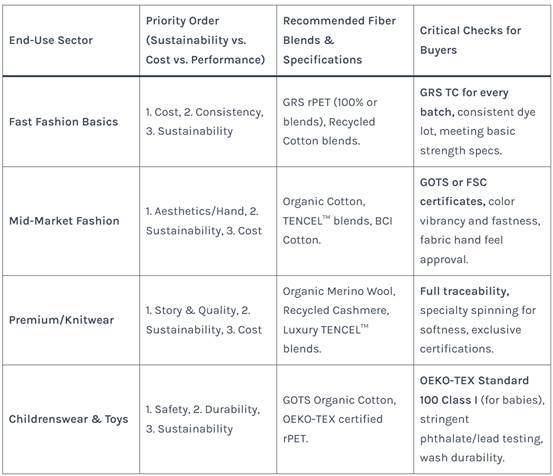
The right choice depends on the final product’s price point, performance needs, and sustainability narrative.
Table 3: Eco-Yarn Selection Matrix by End-Use Application
5. Part 4: Sourcing Deep Dive: The China Factor
China is no longer just the world’s factory for cheap yarn; it’s a leading producer of scale for sustainable options, especially in rPET and recycled cotton.
- eco friendly yarn Supplier Types: Vertically integrated giants (e.g., Texhong, Weiqiao) offer massive volume and stability. Specialized sustainable mills offer innovation and agility but may have higher MOQs for custom blends.
- Cost Drivers: The premium for certified eco-yarn (5-25%+) comes from costlier raw materials (PCR flakes), certification audits, and often more careful processing. The value is in market access and risk mitigation.
6. Part 5: Quality Assurance and Risk Mitigation
- Certificate Authentication: Always verify the certification body (e.g., Control Union, ITS) and the unique certificate number online. Request the Transaction Certificate (TC) for GRS/OCS, which links the specific batch you buy to the certified material input.
- Lab Testing: Beyond certificates, conduct physical tests: yarn count/denier, strength, and twist. For chemical safety, test for pH, formaldehyde, and heavy metals, even if OEKO-TEX is claimed, as a due diligence step.
7. Part 6: Future Trends
- Chemical Recycling: Technologies to break down polyester-cotton blends into new fibers will revolutionize recycling.
- Regenerative Fibers: Cotton and wool from farms that improve soil health will be the next premium tier.
- Digital Traceability: QR codes on yarn cones linking to blockchain-recorded lifecycle data (carbon, water) will become a standard buyer request.
8. Frequently Asked Questions (FAQ)
Q1: Is GRS-certified recycled polyester (rPET) suitable for all types of knitting?
A1: Yes, but with considerations. rPET filament is excellent for technical knits and fleece. For softer apparel, rPET spun yarn (where recycled flakes are spun into staple fiber) is used, often in blends with organic cotton or TENCEL™ to improve hand feel. Ensure the yarn construction (filament vs. spun) matches your knitting machine and desired fabric hand.
Q2: We want a “natural” story but need performance. What are the best eco-blends?
A2: High-performance natural blends are key.
- TENCEL™ Lyocell (30-50%) / Organic Cotton (50-70%): Provides drape, moisture management, strength, and a silky hand.
- Recycled Merino Wool / Recycled Nylon (Econyl®) (80/20): Adds durability and stretch recovery to luxury wool.
- Organic Cotton / rPET (50/50): A cost-effective blend that improves the durability and wicking of cotton.
Q3: How do we ensure the color consistency of eco-yarns, especially recycled ones?
A3: This is a major challenge with recycled fibers due to feedstock variation.
- Specify Solution-Dyed (Dope-Dyed) rPET: Color is added to the polymer melt, guaranteeing exceptional colorfastness and batch-to-batch consistency. This is the gold standard.
- For natural fibers, work with spinners who do large-lot blending of raw materials before spinning to homogenize.
- Always order a bulk production sample and approve it against a lab dip before full production.
Q4: What is the true price premium for GOTS organic cotton vs. conventional cotton yarn?
**A4: The premium varies but typically ranges from **15% to 30%, depending on count, origin, and spinner. This covers the costs of organic farming (lower yield), certification, and segregated processing. The business case includes brand value, compliance with brand mandates, and reduced chemical risk in your supply chain.
Q5: For plush toys, is recycled polyester (rPET) safe and durable enough?
A5: Absolutely, and it’s becoming the industry benchmark. GRS-certified rPET fiberfill is durable, hypoallergenic (vs. some natural fills), and provides a consistent loft. For safety, you must specify fiber that meets all applicable toy safety standards (e.g., EU EN71, US ASTM F963) for flammability, heavy metals, and phthalates, regardless of its recycled status.
Q6: How do we handle end-of-life claims for our products made with these yarns?
A6: Be precise. A 100% GRS rPET garment can be truthfully marketed as “made from recycled materials” and is recyclable again in theory. However, for blends or natural fibers, current industrial recycling is limited. More accurate claims are: “Designed for durability,” or “Made from biodegradable TENCEL™ Lyocell,” which will compost under industrial conditions. Avoid generic “biodegradable” claims without specifying the environment.
Q7: Can we trust “self-declared” recycled content without a GRS certificate?
A7: No, not for serious sourcing. A GRS certificate with a valid Transaction Certificate is the only industry-accepted proof of recycled content and responsible processing. Self-declaration carries high reputational and legal risk, especially in markets with strict green claims laws (like the EU).
Q8: What’s the lead time impact of sourcing certified eco-yarns from China?
**A8: Expect lead times to be *15-30% longer* than for conventional equivalents. This accounts for the more complex sourcing of certified raw materials, segregated production runs to prevent contamination, and the certification issuance process. Plan your sourcing calendar accordingly.**
9. Building a Credible and Competitive Sustainable Product Line
Selecting eco-friendly knitting yarn is a strategic process that fuses technical acumen with ethical sourcing. It moves beyond checking a box to building a verifiable, transparent, and resilient supply chain. By mastering specifications, demanding rigorous certification, and aligning yarn properties with end-use, you transform sustainability from a cost center into a core driver of innovation, brand value, and customer trust. In a market increasingly skeptical of greenwashing, the diligence you apply in yarn selection becomes your most powerful statement of authenticity.