China’s Advantage in Metal Injection Molding Parts Production
The global manufacturing landscape has witnessed significant changes over the past decade, with advanced production techniques reshaping the way components are designed, fabricated, and deployed. Among these innovations, metal injection molding (MIM) has emerged as a game-changer. It allows for the production of complex, high-precision metal parts at scale, meeting the growing demand from industries such as automotive, aerospace, medical, and electronics. In this evolving market, China Metal Injection Molding Parts has emerged as a dominant force, redefining standards and setting benchmarks for quality and efficiency.
Rapid Industrial Growth and Investment in Technology
One of the primary reasons for China’s dominance in the MIM market is the country’s rapid industrialization and continuous investment in technology. Over the past two decades, China has prioritized the development of advanced manufacturing sectors, with a strong emphasis on precision engineering. The government’s support through incentives, tax benefits, and funding for research and development has enabled local MIM companies to adopt cutting-edge machinery and automated production lines.
This investment has significantly reduced production costs while improving precision and efficiency. Compared to other regions, Chinese MIM manufacturers can produce high-quality parts in large volumes without compromising on tolerances or surface finish. As a result, companies worldwide increasingly source their components from China to benefit from the combination of affordability and quality.
Skilled Workforce and Engineering Expertise
Another critical factor contributing to China’s leadership in metal injection molding is the availability of a skilled workforce. Chinese engineers and technicians have gained extensive experience in working with a variety of metals, including stainless steel, titanium, and nickel alloys, and mastering the complex processes involved in MIM, such as powder preparation, feedstock mixing, injection molding, debinding, and sintering.
This expertise allows Chinese manufacturers to cater to industries requiring ultra-precise components, such as medical devices and aerospace applications. The ability to consistently deliver intricate geometries and tight tolerances has made China Metal Injection Molding Parts highly sought after in global supply chains. Furthermore, ongoing training programs and collaboration with research institutions ensure that the workforce remains ahead of global trends and technological advancements.
Economies of Scale and Competitive Pricing
China’s manufacturing ecosystem is uniquely positioned to leverage economies of scale. With numerous MIM facilities operating across the country, suppliers can share resources, standardize processes, and optimize supply chains. This concentration of production capabilities reduces overhead costs and enables manufacturers to offer highly competitive pricing without sacrificing quality.
Competitive pricing is crucial in industries where cost-efficiency is as important as performance. By producing large volumes at lower costs, Chinese MIM suppliers allow their clients to maintain profitability while integrating high-performance components into their products. This advantage has cemented China’s reputation as a preferred source for metal injection molding parts on a global scale.
Advanced Research and Development
Innovation plays a pivotal role in sustaining China’s lead in the metal injection molding sector. Numerous Chinese companies have invested heavily in research and development to improve materials, optimize molding techniques, and enhance post-processing methods. By collaborating with universities, material science labs, and global technology partners, these companies have developed proprietary alloys and processes that enhance mechanical properties, corrosion resistance, and surface finish of MIM components.
Such technological advancements allow Chinese manufacturers to meet the increasingly stringent requirements of industries such as aerospace, defense, and medical devices. The continuous focus on R&D has not only expanded the range of parts that can be produced but also ensured faster turnaround times and better performance characteristics, keeping China Metal Injection Molding Parts at the forefront of the market.
Strategic Supply Chain Management
A robust and well-integrated supply chain is essential for any manufacturing hub, and China excels in this regard. The country has established an extensive network of raw material suppliers, logistics providers, and specialized MIM service providers, enabling seamless coordination across the production process. This integration reduces lead times and ensures consistent quality control throughout the supply chain.
In addition, China’s geographic advantage, with easy access to global shipping routes and ports, facilitates efficient export of MIM components to major markets in North America, Europe, and Asia. Businesses sourcing from China benefit from timely deliveries, minimizing disruptions in their production cycles and enabling just-in-time manufacturing practices. The efficiency and reliability of the supply chain further strengthen China’s leadership position in the MIM market.
Government Policies and Industry Support
China’s government has actively promoted the growth of high-precision manufacturing sectors, including metal injection molding. Policies aimed at fostering innovation, supporting startups, and creating industrial clusters have provided companies with a conducive environment to grow and compete internationally.
Financial incentives, grants for R&D projects, and preferential tax treatment for high-tech manufacturing have encouraged companies to adopt the latest MIM technologies and expand production capabilities. Furthermore, China has invested in certification and standardization programs to ensure that domestically produced MIM parts meet or exceed international quality benchmarks, boosting global confidence in Chinese-made components.
Diverse Industry Applications
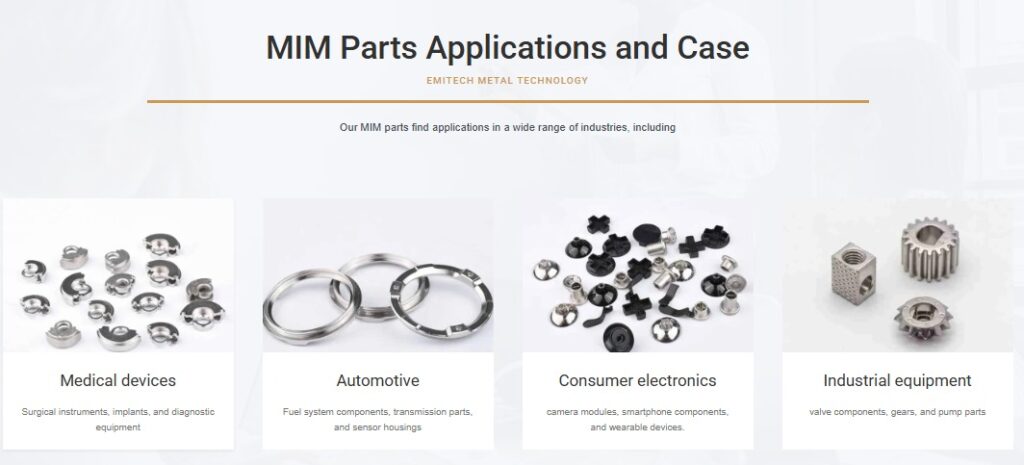
The versatility of metal injection molding technology has also contributed to China’s stronghold in this sector. MIM parts are used across a wide array of industries, from automotive components like gears and fasteners to medical implants and surgical instruments. Consumer electronics, including connectors and miniature components, also benefit from the precision and complexity offered by MIM.
China’s ability to cater to multiple sectors simultaneously gives it an edge over competitors in regions where MIM production is more specialized or limited. Manufacturers in China can rapidly adapt to emerging demands and develop tailored solutions, making China Metal Injection Molding Parts highly attractive to international buyers seeking diverse applications.
Emphasis on Quality Assurance
Quality assurance is a critical differentiator in the metal injection molding market. Chinese manufacturers have implemented rigorous quality control measures, including automated inspection systems, statistical process control, and non-destructive testing methods. These measures ensure that every component meets design specifications and industry standards.
By maintaining high-quality output consistently, Chinese MIM suppliers have earned the trust of global clients, particularly in sectors where failure is not an option, such as medical devices and aerospace. The reputation for reliability and performance reinforces China’s status as the global leader in metal injection molding parts.
Future Outlook
The future of the China Metal Injection Molding Parts market looks promising, with continued growth expected in both domestic and international demand. Emerging technologies such as additive manufacturing, hybrid MIM processes, and advanced material development are likely to further enhance the capabilities of Chinese manufacturers. As industries increasingly seek lightweight, high-strength, and complex components, the demand for MIM parts is projected to rise, solidifying China’s leadership position.
Furthermore, China’s ongoing commitment to technological advancement, skilled workforce development, and efficient supply chain management ensures that it will remain a dominant player in the global market. Companies worldwide will continue to rely on China not just for cost-effective solutions, but also for cutting-edge expertise in metal injection molding.
Conclusion
China’s leadership in the metal injection molding parts market is the result of a combination of factors: significant investment in technology, a skilled workforce, economies of scale, strong supply chain management, government support, and a focus on innovation and quality. By leveraging these advantages, China has positioned itself as the go-to destination for high-precision, reliable, and cost-effective MIM components.
The global manufacturing community increasingly recognizes the strategic importance of sourcing from China, as China Metal Injection Molding Parts consistently meet the diverse needs of industries ranging from automotive to aerospace and medical devices. With continued advancements in technology and production capabilities, China’s dominance in the MIM market is set to strengthen even further in the coming years.
